
Oversized clothing has a branding problem. Worn without intention, it reads as “didn’t try.” Worn with intention, it’s one of the most versatile silhouettes in modern fashion — and it has been for decades, from 1980s hip-hop culture to 1990s grunge to the luxury runways of the last ten years.
The difference between the two outcomes almost never comes down to the garment itself. It comes down to proportion. Oversized fashion moved firmly into the mainstream over the past decade, largely on the back of streetwear’s influence on luxury.
Under creative director Demna Gvasalia, Balenciaga made oversized silhouettes a core part of its identity starting in 2015, growing the brand from roughly a $400 million business into one valued at over $2 billion before Demna’s departure in 2025.
That’s not a trend-cycle footnote — that’s a commercial signal that intentional oversized dressing has real staying power. Here’s how to get the effect right, whether you’re working with one oversized piece or building a full loose-fitting outfit.
1. Understand the Difference Between Oversized and Just Too Big
Oversized clothing is a deliberate design choice. The shoulder seams, the proportions, the drape — all of it is built for the loose fit. “Too big” is just the wrong size, full stop.
The visual tell: an oversized piece still has a shoulder line sitting in roughly the right place, even when everything below it is loose. A piece that’s genuinely too large usually has that shoulder seam sliding down your arm.
Do this: Check the shoulder seam placement before deciding whether an oversized piece is working with your frame or just hanging off it.
2. Anchor Volume with One Fitted Piece
The single most reliable oversized styling rule, and one worth committing to memory: if one half of the outfit is loose, the other half should be more fitted.
An oversized sweater with straight-leg jeans, or an oversized blazer with slim trousers — either keeps the silhouette balanced instead of shapeless.
Do this: Before adding a second oversized piece to an outfit, ask whether the silhouette still has a defined shape. If it doesn’t, swap one piece for something more fitted.
3. Tuck Strategically to Create a Waistline
Fully tucking an oversized top can look overly controlled. Leaving it completely untucked can swallow the waist entirely. A front tuck, or a loose partial tuck, lands in the middle — enough definition to establish shape while the piece still feels relaxed.
Do this: Try a front-only tuck with an oversized shirt or sweater over jeans or a skirt to introduce a waistline without losing the silhouette’s ease.
4. Use Layering to Build Intentional Shape
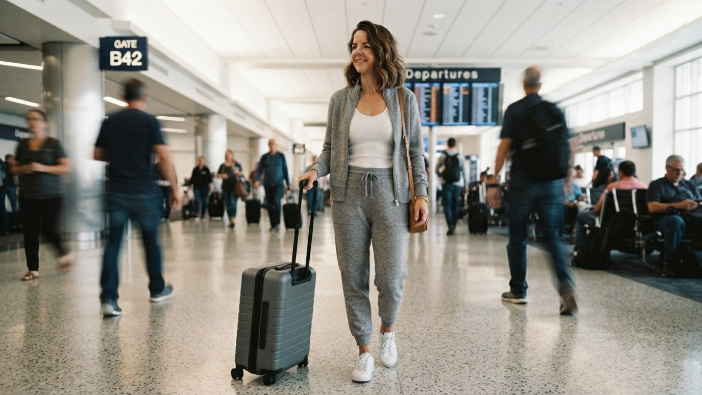
Layering a fitted piece underneath or a structured piece over an oversized garment adds visual definition. A cropped jacket over an oversized dress, or a fitted tank under an open oversized shirt, both introduce shape without altering the oversized piece itself.
Do this: Layer with a piece that has a clean, defined edge — a cropped hem, a structured shoulder — to contrast against the volume of the oversized item.
5. Choose the Right Footwear to Ground the Outfit
Footwear does a lot of quiet work in oversized outfits. A chunky sneaker or boot grounds heavy volume up top, while a sleeker shoe can balance an oversized bottom.
The wrong shoe — something too delicate under a very voluminous outfit, for instance — can make the whole look feel top-heavy or unfinished.
Do this: Match shoe weight to outfit volume. Heavier silhouettes generally pair better with a slightly more substantial shoe.
6. Use Accessories to Reintroduce Structure
A belt at the natural waist, a structured bag, fitted sunglasses — these small, deliberate lines do a lot of work in an otherwise loose outfit. They’re what signal the volume was a choice, not an accident.
Do this: Add one structured accessory — belt, bag, or a clean pair of sunglasses — to any fully oversized outfit as a visual anchor.
7. Balance Oversized Tops with Fitted Bottoms (and Vice Versa)
This is the most foundational rule in the whole list: rarely go oversized on both halves of the body, unless you’re deliberately chasing a fully relaxed, cocoon-like silhouette on purpose.
An oversized top over slim or straight bottoms, or wide-leg oversized trousers with a fitted top — both read as intentional proportion, not an accident.
Do this: Pick one half of the body to keep close to its actual shape, and let the other half carry the volume.
8. Choose Fabric That Holds Its Shape
Stiffer fabrics — structured cotton, denim, wool blends — hold an oversized silhouette the way it’s meant to sit. Very soft or clingy fabrics tend to collapse into shapelessness instead. The drape is really what determines whether “oversized” reads as architectural or just loose.
Do this: For structured oversized pieces like blazers and coats, look for fabric with enough body to hold its own shape when you move.
9. Cuff or Roll to Reveal Proportion Points
Rolling sleeves or cuffing oversized trousers reveals the wrist and the ankle — two proportion points that ground an otherwise voluminous outfit. Small adjustment, surprisingly big visual difference, and you haven’t altered the garment at all.
Do this: Roll oversized sleeves to just past the wrist, and cuff oversized trousers to show a sliver of ankle — especially with a low-top sneaker or loafer.
10. Treat Oversized Dressing as a Styling Choice, Not a Default
The difference between “intentionally oversized” and “sloppy” is almost always visible confidence and coordination — an outfit where every piece, even the loose ones, seems chosen with purpose.
Oversized dressing works best as one deliberate element within an outfit, not as a blanket approach applied without any other consideration.
Expert Styling Tips
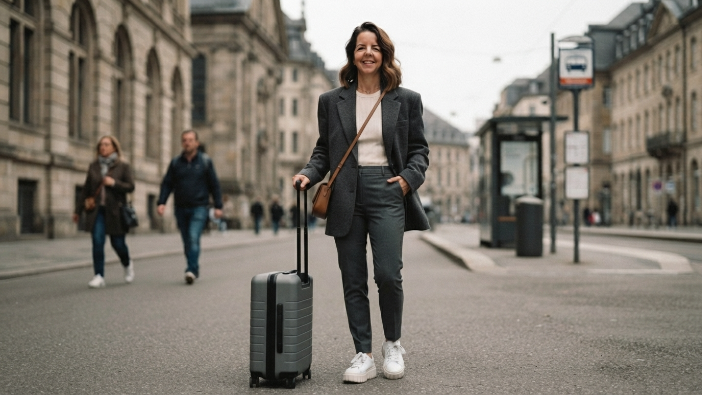
- Start with one oversized piece, not a full outfit, if you’re new to the silhouette — a single oversized blazer or sweater is easier to balance than head-to-toe volume.
- Shoulder seam placement is your fastest fit check. If it sits noticeably past your natural shoulder, decide whether that’s the intended drop-shoulder design or simply too large.
- Weight distribution matters as much as proportion. A heavy oversized coat pairs better with a lighter, more fitted layer underneath than with another bulky piece.
- Oversized doesn’t mean shapeless everywhere. Even a relaxed silhouette benefits from one defined point — a cinched waist, a rolled cuff, a visible ankle.
- Photograph your outfit before leaving the house. A phone photo often reveals proportion issues that aren’t as obvious in a mirror.
Real-World Examples
Demna Gvasalia’s Balenciaga era (2015–2025)
Under Demna’s direction, Balenciaga made oversized, utilitarian silhouettes a defining part of its identity, elevating streetwear-influenced volume through luxury construction and materials.
The brand grew from roughly $400 million to over $2 billion in value across his decade there — commercial validation that oversized dressing, done with intention and real construction quality, outlasts a passing trend cycle.
His later move to Gucci in 2025 showed the flip side of the same principle: reports on his collections there noted a deliberate pivot toward tighter silhouettes, which says something useful — oversized dressing is a design choice you apply on purpose, not a default setting. Source: Highsnobiety; Sizebay industry analysis
The 1990s hip-hop and grunge oversized movements
Two very different subcultures landed on oversized silhouettes independently in the 1990s. Hip-hop artists popularized baggy tracksuits and oversized T-shirts.
Grunge musicians layered oversized plaid shirts over looser tops as a deliberate anti-fashion statement. Neither was an accident of poor fit — both used the silhouette itself to say something.
Vetements and the “hypertrophied” oversized silhouette
Starting around 2014, the label Vetements — also founded by Demna Gvasalia — built its early identity on deliberately exaggerated proportions: oversized sleeves, dramatically dropped shoulders, inspired by thrift-store finds.
It pushed oversized tailoring out of niche design territory and into something mainstream and replicable, which eventually filtered all the way down to accessible retailers.
Conclusion
Oversized clothing looks intentional the second proportion enters the equation — one fitted piece to balance the volume, a tuck or roll to reveal a waist or wrist, footwear that matches the outfit’s overall weight.
None of this asks you to give up the relaxed, comfortable appeal that made oversized dressing popular in the first place. It just asks you to treat volume as a choice rather than something you fell into.
Start with one oversized piece, try a couple of these balancing techniques, and build your confidence in the silhouette from there.
FAQ
How do I know if oversized clothing actually fits me, or if it’s just too big?
Check the shoulder seam. In genuinely oversized garments, it typically still sits close to your natural shoulder line even though the rest of the garment is loose. If the seam slides well down your arm, the piece is probably just too large rather than intentionally oversized.
What’s the easiest way to style one oversized piece?
Pair it with something more fitted. An oversized sweater with straight-leg jeans, or an oversized blazer with slim trousers, is about as simple as the formula gets.
Should I tuck oversized tops in?
A partial or front tuck usually works best — it introduces a waistline without killing the relaxed silhouette entirely.
What shoes work best with oversized outfits?
Chunkier sneakers or boots ground heavier volume well. Sleeker shoes work better when the oversized element is limited to the bottom half.
Can oversized clothing work for more formal occasions?
Yes — an oversized blazer over more fitted, polished pieces underneath has become a fairly common pairing in both streetwear-influenced and higher-end fashion.
Is oversized fashion just a passing trend?
Not really. Oversized silhouettes have cycled through fashion for decades — 1920s relaxed menswear, 1990s hip-hop and grunge, 2010s–2020s luxury streetwear. That’s a recurring pattern, not a one-off moment.