Introduction
There’s a persistent myth in fashion that looking put-together requires standout pieces — statement coats, loud prints, the kind of thing a stranger stops you on the street to ask about.
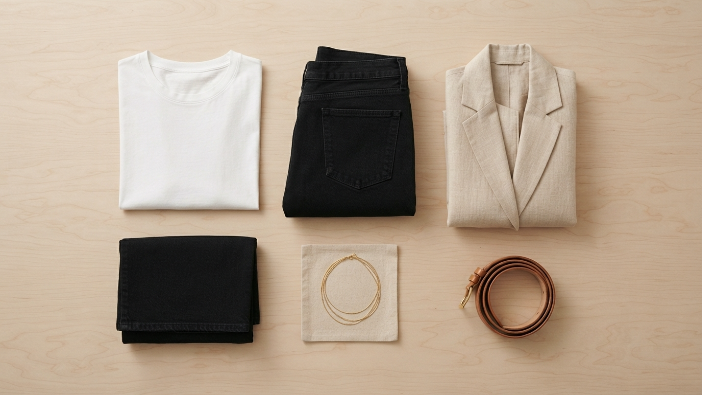
Truth is, most people you actually notice on a given day are wearing a white t-shirt, jeans, and a blazer. Nothing wild. What separates a basic outfit that looks like “just clothes” from one that looks deliberate isn’t the clothes themselves. It’s how they’re put together.
Learning to style basics is genuinely one of the more useful skills in personal style — it stretches fewer pieces further, and it kills that nagging feeling that you need to keep buying new things just to look finished. Here are fifteen tricks, no dramatic pieces required.
1. The Tuck, All Three Ways
Tucking changes an outfit’s whole silhouette, and most people only ever use one version. A full tuck gives a clean, defined waist — pairs well with anything high-rise. A French tuck (front only, back left loose) softens things and adds a bit of casual polish without looking like you tried too hard.
A half-tuck, just one side, throws in some asymmetry and movement. Rotate between the three and suddenly the same shirt and jeans feel like three different outfits. Costs nothing. Takes five seconds.
2. Layer for Texture, Not Just Warmth
Layering is about visual interest as much as staying warm. A plain t-shirt under an open button-down, or a tank under a cardigan with the sleeves pushed up, adds depth without needing pattern or color. Look for layering pieces with slightly different textures — a ribbed tank under a smooth cotton shirt, say — so the layers look intentional instead of accidental.
3. Let Proportion Do the Styling Work
This might be the single highest-leverage trick on this whole list: pair loose with fitted. Oversized sweater, fitted bottoms. Boxy jacket, slim trousers. Wide-leg pants, a tucked or cropped top. Basics almost always look more finished when there’s real contrast in silhouette, instead of everything sitting at the same volume.
4. Let One Accessory Carry the Whole Outfit
A plain white tee and jeans can go from forgettable to considered with a single well-chosen accessory — a structured bag, a statement belt, layered gold jewelry. The trick is restraint everywhere else, so that one piece actually has room to register instead of competing with five others.
5. Play With Sleeve and Hem Lengths
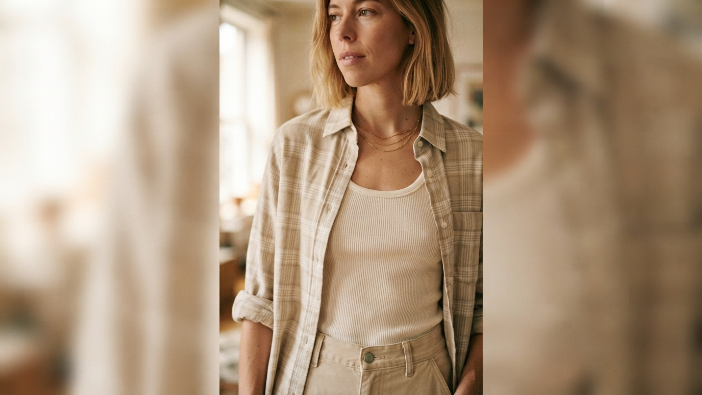
Rolling sleeves to three-quarter length, cuffing your jeans once at the ankle, tying a shirt at the waist — these are tiny, free, seconds-long adjustments that change proportion instantly. They’re some of the most underused tricks out there, simply because people forget clothes can be adjusted in real time, not just worn exactly as they came off the hanger.
6. Build a Color Story Around Neutrals
Basics tend to live in a neutral palette — white, black, navy, beige, gray — and that’s an advantage, not a limitation. Once you’ve settled on your neutral base, adding a single accent color (a burgundy scarf, an olive jacket) stands out far more than it would buried in a busier, multi-colored outfit. Color coordination here is less about matching and more about knowing when to hold back.
7. Mix Casual and Elevated Pieces on Purpose
One of the most reliable moves you can make: combine something dressed-down with something dressed-up. Sneakers with tailored trousers. A blazer over a plain tee and jeans. A silk cami with denim. That contrast between formal and casual is exactly what reads as “styled” instead of “thrown on.”
8. Choose Outerwear That Changes the Outfit’s Whole Character
A trench coat, a denim jacket, and a wool coat sitting over the exact same t-shirt-and-jeans base will read completely differently — polished, casual, elevated. Building two or three outerwear options that each shift the mood of your basics is one of the most efficient tricks around, since outerwear is often the very first thing people notice.
9. Use Belts for Shape, Not Just Function
A belt at the natural waist over an oversized shirt or dress adds structure that basics often lack on their own. This trick works especially well with shapeless silhouettes — slip dresses, oversized button-downs, straight-cut coats.
10. Rotate Necklines Intentionally
A crew neck, v-neck, and boat neck tee all photograph and wear differently, even in identical color and fit otherwise. Knowing which necklines actually suit your face and frame — and cycling through a couple of go-to options — adds variety to a basics-heavy wardrobe without adding any real complexity.
Shoes basically decide the tone of an outfit built from basics. Same jeans, same tee — sneakers make it sporty, loafers make it polished, heeled boots push it toward elevated.
If your wardrobe’s small, pick two or three shoe styles that each pull things in a genuinely different direction. Don’t buy five variations on the same sneaker.
12. Swap Fabrics With the Season, Not Just Layers
A simple shift dress in linen reads completely differently than the same shift dress in a heavy knit. Seasonal dressing isn’t only “add a coat when it’s cold” — it’s picking fabric weights that actually match the season so nothing looks out of place, even indoors.
13. Pick a Uniform, Then Mess With the Details
A lot of the most consistently well-dressed people you know are secretly wearing some version of the same formula on repeat — fitted top, wide-leg trouser, loafer — and just changing color, texture, and accessories. That’s not boring. It’s efficient. Fewer decisions, and everything still feels like you, specifically.
14. Scarves Are Cheap and Do a Lot
Tied around the neck, looped through a bag handle, worn as a headband — a scarf adds color and a sense of intention for almost nothing. It’s underused mostly because scarves feel a little old-fashioned to some people. Styled right, though, they read as personality, not costume.
15. Photograph Your Outfits and Build a Personal Reference Library
Snap a quick photo of any outfit that felt right before you head out. Over a few months, this turns into a personal lookbook showing you which combinations of your basics actually work for your body and your life — far more useful than any general style guide, because it’s specific to you.
A Few Expert Notes
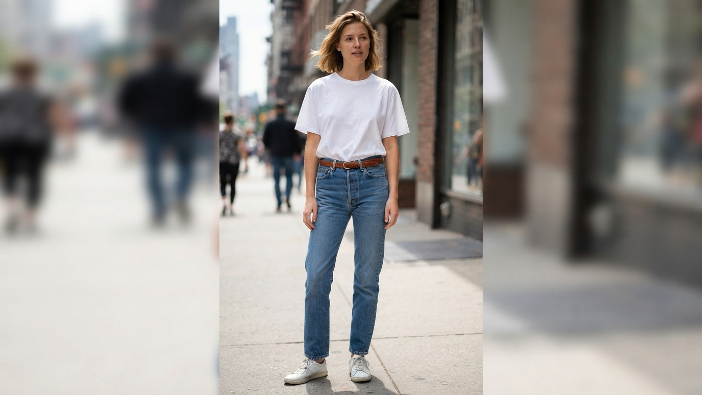
- Invest in one exceptional plain t-shirt rather than five mediocre ones. The fit and fabric weight on your most-worn basic matters more than having variety.
- Keep a “styling drawer” with belts, scarves, and jewelry visible and within reach, not tucked away in a drawer you forget exists. You’ll actually use the accessories you can see.
- Test proportion pairings in the mirror before committing, especially with oversized pieces — mirrors and photos reveal fit issues that feel invisible when you’re getting dressed in a hurry.
- Rotate, don’t replace. Most people don’t need more basics. They need a better system for combining the ones they already own.
Does This Actually Hold Up?
A few things worth knowing if you want more than “trust me”:
Courtney Carver’s Project 333 challenge — dress with 33 items or fewer, everything included, for three months straight — has been tried by thousands of people at this point. What keeps coming up in how participants talk about it: restriction pushes creativity.
You start combining things in ways you wouldn’t bother with if your closet were bottomless. It’s a decent real-world argument that skill, not wardrobe size, is what makes an outfit look intentional.
There’s also a broader shift happening in how people shop. McKinsey and Business of Fashion’s research on 2026 points to resale growing two to three times faster than new retail, partly because tariffs are pushing prices up and partly because people are just tired of buying constantly.
That lines up with everything above — fewer, better basics, restyled well, isn’t a trend. It’s closer to a permanent shift in how people are actually shopping.
And then there’s quiet luxury, which is really just “basics, done unusually well.” Well-cut trousers, good knitwear, neutral outerwear, styled with restraint instead of a statement piece anywhere.
Even Pantone’s pick for 2026 — a calm, quiet white — echoes that same expensive-but-not-shouting-about-it look. Basics-first dressing isn’t a fallback anymore. It’s its own category.
Last Thing
Styling basics isn’t really about the clothes. It’s a handful of repeatable moves — tucking, proportion, layering, one accessory placed with intent. You don’t need a bigger closet. You need to start treating what’s already in it as building blocks instead of finished outfits. Try two or three of these this week with stuff you already own, and pay attention to how different it feels.
Questions People Actually Ask
How do you make basic clothes look expensive?
Fit first. Tailored basics in the right proportion read as expensive no matter the price tag. After that, one intentional accessory or layering piece — not five competing ones.
What are the actual must-have basics?
A genuinely well-fitted white tee, dark jeans (straight or wide-leg, your call), a neutral blazer, a slip or shift dress, and one coat that isn’t an afterthought. That’s most of the work done.
How many pieces do you really need?
Somewhere around 20 to 35, if they’re chosen well and actually work together — that’s roughly the Project 333 range, and it holds up.
Isn’t it boring wearing the same basics constantly?
Not really, no. Plenty of stylish people — public figures included — build their entire look around repeating basics and just varying the details. It has a name (uniform dressing) precisely because it’s a real strategy, not a compromise.
Fastest way to make a basic outfit look styled instead of thrown on?
Contrast in proportion — fitted with loose — plus one considered accessory. That’s it. Two moves.