
Somewhere along the way, “dressing for your body shape” turned into a rulebook — lists insisting pear shapes must avoid this, apple shapes must hide that, and hourglass shapes are somehow the gold standard everyone else is measured against.
Most of that framing does more harm than good. It treats bodies like problems to be solved rather than starting points to be dressed well.
A more useful way to think about this topic isn’t “what should I hide,” but “what fit and proportion choices make me feel good in what I’m wearing.” That question works for every body, and it doesn’t require sorting yourself into a category first.
Fit Matters More Than Shape Ever Will
Two people with the exact same body measurements can look completely different in the same garment, purely based on fit.
Regardless of size, form, or trend, clothing that is too tight in the wrong areas, too loose in others, or just cut for a different proportion than yours will always look less good than something properly fitted.
This is the one most disregarded element influencing how clothes appear on a body: not whether you’re “supposed” to wear something but rather whether it truly fits you.
Understanding Proportion, Not Restriction
Instead of shape categories, it helps to think in terms of proportion — where your outfit visually draws the eye, and how the top and bottom halves of your body relate to each other in what you’re wearing.
A longer top with a fitted bottom creates one kind of line; a fitted top with a fuller bottom creates another. Neither is more correct — they’re simply different visual effects, and which one feels right depends entirely on personal preference, not a fixed rule about your body.
Playing with proportion is less about disguising anything and more about deciding what feeling you want an outfit to create: elongated, balanced, structured, relaxed. That decision belongs to you, not to a body-shape chart.
Waistlines Are a Tool, Not a Requirement
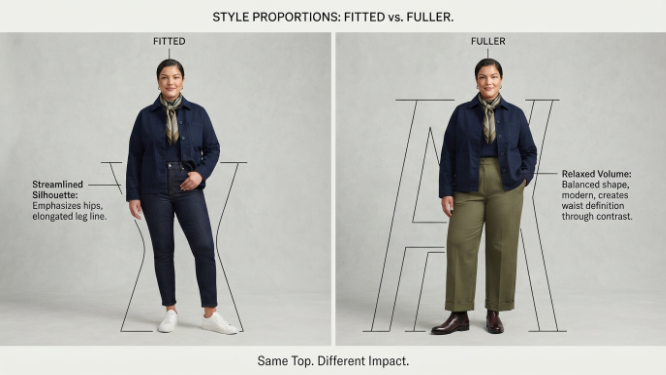
One of the most adaptable styling tools at hand, defining the waist—through a fitted top, a belt, or a wrap style—works on every body type, not just a particular “shape.”
Having said that, a lot of individuals choose a straighter, less waist-defining silhouette; this is equally as legitimate a design option. The issue is not that everyone should define their waist; rather, it’s that doing so is an option worth exploring rather than a requirement everyone has to abide by.
Necklines and Tops Change More Than People Expect
The neckline of a top can shift how an entire outfit reads — a deep V elongates, a boat neck widens the shoulder line, a turtleneck creates a cleaner, more streamlined look. None of these are universally “better.”
They’re tools for creating different visual effects depending on what you’re going for that day, and experimenting with different necklines is one of the lowest-effort ways to discover what you personally like on your frame.
Comfort Is Not the Opposite of Style
People often believe that comfortable clothes and flattering clothing are distinct and that occasionally looking nice calls for discomfort.
Almost always more comfortable than ill-fitting ones, clothes that fit correctly in reality are not less so. A costume requiring ongoing tweaking, pulling, or tugging seldom looks as nice as one that just fits and lets you move freely.
Tailoring Solves What Sizing Charts Can’t
Off-the-rack clothing is built for an average, and almost nobody is exactly average in every proportion.
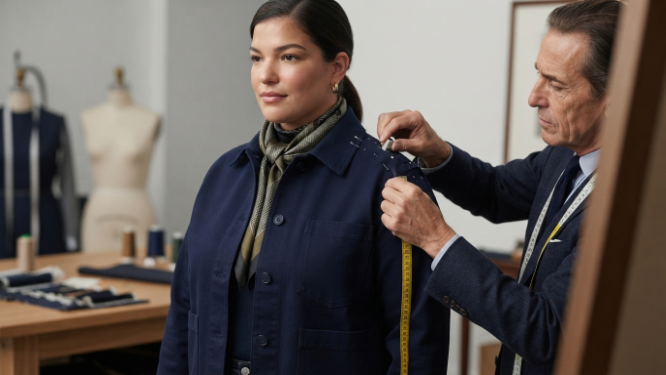
Trousers that fit the hips but pool at the ankle or a jacket that fits the shoulders but not the waist are just unadjusted; they are not an indication you’re the “wrong shape” for that garment.
A nearby tailor changing hemlines, waists, and shoulders might drastically alter the appearance of a piece on your particular body—frequently for little expense.
Trust Your Own Eye Over Generic Rules
The most reliable body-shape advice isn’t a chart at all — it’s paying attention to how you personally feel in different cuts, fits, and proportions, and noticing what you gravitate toward when you’re not thinking about rules.
Confidence in an outfit shows more visibly than any specific cut or silhouette choice ever could, and it’s not something a body-shape category can dictate.
There Is No Universal “Right” Way to Dress a Body
Every body is different, every preference is valid, and the goal of dressing well isn’t to conform to a shape category — it’s to understand fit, experiment with proportion, and choose what genuinely makes you feel good. That’s a far more useful framework than any list of shape-based dos and don’ts.
FAQ
How do I know what my body shape is?
Body shape is often loosely categorized by comparing shoulder, waist, and hip measurements, but this framework is more useful as a general reference than a strict rule. Paying attention to fit and personal preference tends to matter more than identifying an exact category.
Are body shape rules like “pear” or “apple” actually accurate?
These categories can offer a general starting point, but they oversimplify real bodies, which rarely fit neatly into one type. Fit, proportion, and personal comfort are more reliable guides than any fixed category.
What’s the fastest way to make an outfit look more flattering?
Check the fit first — many “unflattering” outfits are simply the wrong size or cut for that specific body, not a sign the style itself doesn’t work. Basic tailoring adjustments often solve this quickly.
Do I need to define my waist to look put together?
No. Defining the waist is one styling option among several, not a universal requirement. Straighter, less structured silhouettes work well for plenty of people and preferences.
Can clothes be both flattering and comfortable?
Yes, and ideally they should be both. Properly fitted clothing is generally more comfortable than ill-fitting clothing, not less — the two goals usually align rather than conflict.
Is tailoring worth it for everyday clothes, not just special occasions?
Often, yes. Basic alterations like hemming or taking in a waist can significantly improve how everyday clothing fits and looks, and the cost is usually modest relative to the improvement.