Somewhere along the way, “capsule wardrobe” started sounding like a project reserved for people who can afford a full closet reset of quality basics in one go. It isn’t.
A capsule wardrobe on a budget is really just a smaller, more intentional version of the closet you already have — built gradually, with what you can actually afford, around pieces that earn their space.
You don’t need a magic item count, a strict color scheme, or a closet full of designer labels. What you actually need is to know what you wear, what you don’t, and how to stop buying things that quietly repeat what’s already hanging there, untouched. Here are twelve ways to actually get there without blowing a budget.
1. Figure Out What “Capsule Wardrobe” Even Means
At its core, it’s just a small, curated set of clothes where most pieces mix and match into multiple outfits. It’s not a strict number, and it’s definitely not a minimalist aesthetic requirement — it’s a system.
Courtney Carver’s Project 333 is probably the best-known version: 33 items or fewer, shoes and accessories included, worn for three months straight.
The number 33 isn’t magic, and Carver’s said as much herself — it wasn’t built off some formula, just a workable range she landed on. What actually matters is intentionality. Every single piece in rotation is something you genuinely reach for.
2. Go Through What You Already Own First
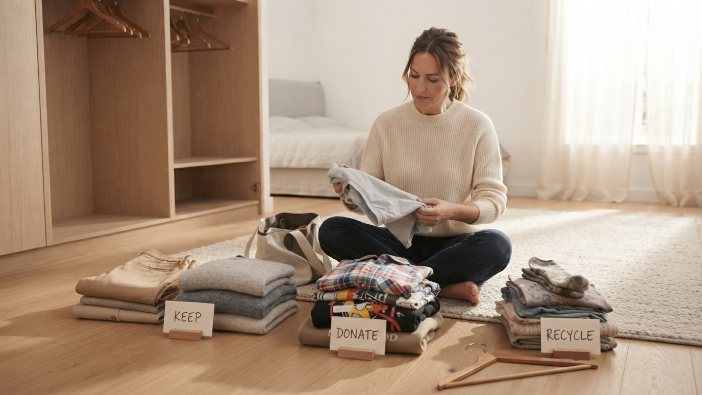
Before you spend anything, sort your closet into three piles — worn regularly, worn occasionally, untouched for a year.
That last pile tells you almost everything you need to know about mistakes to avoid going forward: an impulse trend buy, a basic that never fit right, a color that clashed with everything else you own.
Most people find a starter capsule already sitting in their closet once they do this. You probably own more versatile stuff than you give yourself credit for.
3. Pick Versatility Over Anything Novel
A budget capsule survives on pieces that can pull double or triple duty. A well-cut pair of trousers that works both in the office and at dinner is worth more, cost-per-wear, than a statement piece that only fits one specific occasion.
Before buying anything new, ask yourself honestly: can I picture at least three outfits with this thing and stuff I already own? If the answer’s no, it’s not ready for the capsule yet, no matter how much you like it on the hanger.
4. Keep the Color Palette Simple

Two or three neutral base colors — navy, camel, black, gray, whatever suits you — plus one or two accents keeps everything in your closet talking to everything else.
This is really the trick that makes a small wardrobe feel bigger than it is. Fewer clashes means more combinations out of the same handful of pieces.
You don’t need to overhaul your color instincts entirely. Just get deliberate about new purchases actually fitting the palette you already gravitate toward.
5. Nail the Basics Before Chasing Trends
Before you go after anything trendy, make sure the fundamentals are covered — jeans or trousers that fit properly, a couple of tops that layer easily, one dependable outer layer, shoes that work across several outfits.
These unglamorous basics are what make everything else function. Trend pieces are the seasoning, not the meal.
6. Slow Down on Impulse Buys
Budget capsules fall apart fastest when impulse purchases keep sneaking in around the edges. A simple rule — wait 48 hours before any non-essential buy, or keep a running wishlist instead of purchasing on sight — quietly cuts out a lot of the stuff that never earns its keep.
7. Shop Secondhand and Sales With a Plan
Secondhand shopping has moved firmly into the mainstream at this point. ThredUp’s 2025 Resale Report found the U.S. secondhand apparel market grew 14% in 2024 — its strongest year since 2021 — with 58% of U.S. shoppers buying secondhand that year, a record.
That means better selection, better platforms, better prices for anyone building a capsule without a huge budget.
The trick is shopping secondhand with the same intentionality you’d use buying new — look for the actual fit and fabric quality you want, not just whatever has the lowest price tag regardless of whether it fits the plan.
8. Spend More Where It Actually Matters
A budget doesn’t mean every single item has to be the cheapest option out there. It means being deliberate about where the money goes.
Spend a bit more on things you wear constantly — a coat, everyday shoes, jeans — and save on stuff you wear less. Quality in the right places stretches the life of the whole wardrobe and means you’re replacing things less often.
9. Actually Build Outfits, Don’t Just Own Clothes
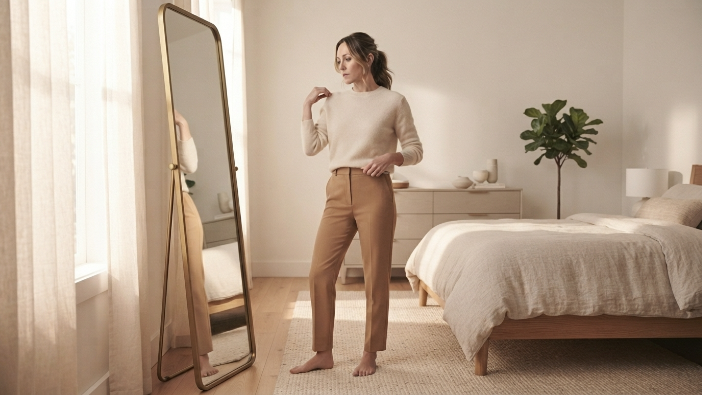
A capsule only works if you use the mix-and-match potential it’s built for. Spend twenty minutes trying new combinations of stuff you already own before assuming you need something new.
It’s genuinely common to find three or four “new” outfits hiding in a wardrobe that felt limited five minutes earlier.
10. Adjust It by Season Instead of Rebuilding It
You don’t need to start over every season. Build around a stable core and layer around it — swap heavier knits and coats for lighter pieces, but keep the base trousers, neutral tops, and shoes mostly the same year-round.
Rotating maybe a third of the wardrobe each season, instead of the whole thing, keeps costs down while it still feels fresh.
11. Watch for the Common Capsule Mistakes
The mistakes that come up over and over: buying trend pieces that don’t match your palette, being too rigid about hitting an exact item count, treating the whole thing as a one-time project instead of an ongoing habit. A capsule wardrobe is something you maintain. It’s not a closet you finish and walk away from.
12. You Don’t Need a Big Budget for Any of This
None of this requires designer labels or a huge upfront spend. It requires editing, planning, and buying with actual intention — three things that cost nothing and save money over time.
A budget capsule might honestly be easier to stick with than an expensive one, since there’s less financial pressure riding on every single purchase.
Expert Styling Tips
- Start with a 10-piece test capsule for one season before committing to a full wardrobe overhaul — it’s less overwhelming and easier to evaluate.
- Keep a “cost-per-wear” mental note. A $40 top worn 40 times costs a dollar a wear; a $15 top worn twice costs more per use.
- Photograph outfit combinations as you build them, so you have a visual reference instead of relying on memory when getting dressed.
- Rotate accessories, not just clothes. A scarf, belt, or different shoes can make the same five pieces feel like new outfits.
- Don’t donate everything from the audit at once. Box up the “maybe” pile for a month before deciding — some pieces earn their place back once you see what’s genuinely missing.
Real-World Examples
Does This Actually Hold Up in Practice?
Courtney Carver’s Project 333, launched back in 2010, challenges people to dress with 33 items or fewer — shoes, jewelry, accessories, all of it — for three months at a stretch.
What started as a personal experiment turned into something bigger; Carver’s said it’s reached people in more than 80 countries at this point.
The real lesson here isn’t the number 33 specifically. It’s the discipline underneath it — pick a fixed, workable set of pieces and actually live with them before adding anything new.
The resale market backs this up, too. ThredUp’s 13th annual Resale Report found the U.S. secondhand apparel market grew 14% in 2024, outpacing the broader retail clothing market by five times over, with online resale specifically growing 23% that same year.
That’s not just better platforms — it’s a real shift in how people value quality and affordability over buying new constantly. For anyone building a capsule, secondhand isn’t a fallback option anymore. It’s a legitimate first stop.
Beyond Project 333, other structured challenges have popped up with similar goals — the “10×10,” building ten outfits from ten items over ten days, or the “30 wears” rule, committing to wear anything new at least 30 times before it counts as a keeper.
These circulate a lot in minimalist fashion and sustainability circles, and they all point at the same underlying idea: versatility and repeat wear are what make a wardrobe efficient. Not the total count of items sitting in it.
Last Thing
Building a capsule wardrobe on a budget was never about owning less just for the sake of it. It’s about owning things you actually use.
Start with an honest audit, build around a simple color palette, lean on secondhand shopping where it makes sense, and let the whole thing evolve gradually instead of trying to finish it in one weekend. The result isn’t a smaller life. It’s just a closet that finally pulls its weight.
Questions Worth Answering
Do I need exactly 33 items to call it a capsule wardrobe?
No. That’s just the number Project 333 uses — one popular version of the idea. A capsule can be any size that actually works for your life and climate.
Is a capsule wardrobe actually cheaper than a normal one?
Generally, yes, over time — you’re buying fewer, more deliberate pieces and cutting down on impulse buys, even if individual items sometimes cost a bit more upfront.
Can I build one entirely secondhand?
Yes, honestly. With the secondhand market growing this fast and offering way better selection than it used to, building most or all of a capsule through resale and thrift is completely realistic now.
How often should I actually update it?
Most people rotate a portion each season — not the whole thing. Keep the foundational pieces year-round and swap the seasonal layers as needed.
What if my style isn’t really “minimalist”?
Doesn’t matter. A capsule doesn’t require a minimalist look at all — you can build one around bold colors or prints just as easily. The versatility principle still applies regardless of aesthetic.
Where do I even start if this feels overwhelming?
The wardrobe audit. Sort what you already own into worn, occasionally worn, and untouched — the next steps almost always become obvious from there.